Tuesday, September 18, 2012

When You Grow Up

How many times have people (including me) asked you what you want to be when you grow up? I often see many students stare back in a look of pure panic because you really don't have any idea what you would like to do when you grow up and are out in the "real world." Don't worry! It is normal to be uncertain of what career you will spend the rest of your life pursuing, but it is helpful for you to start exploring different career fields and considering different jobs that might be a good fit with your strengths, needs, and interests.  

I have been working with a committee of parents, teachers, counselors and other staff to help plan the 2012 Career Fair. Upperclassmen may recall the 2010 Career Fair as this is an effort we hold every other year. The Career Fair will give all students the opportunity to interact one-on-one in an informal setting (during the school day at WKHS) with a variety of different career professionals. I know that in addition to my students, many parents read this blog - and I desperately need your help with this project! We need to find more people to attend the Career Fair and we'd also like additional information about a wide range of careers even if people cannot attend as we will compile the responses in a Career Resource Handbook for students to use as a resource. Adults can help by completing the career questionnaire at www.surveymonkey.com/wkhscareerfair and I would also love it if you could forward the survey to any of your family members, friends, neighbors, or colleagues!

In the meantime, for students who still are at a loss and wouldn't even know a broad area that you might be interested in considering for your future, perhaps it would be worth your time to take a Career Interest Inventory.

The Ohio Career Information System (OCIS) has an online assessment that the district provides access to for WKHS students. You will need to know the username: Kilbourne and password: ohiocis03

And for those students who already have an idea about what careers they are interested in pursuing in the future, I'd recommend checking out the Explorer's programs.  You can find out more information about Explorer's on the WKHS Counselor website.

Here are a few other sites with career related information that you can explore:

Occupational Outlook Handbook: The Occupational Outlook Handbook is a nationally recognized source of career information, designed to provide valuable assistance to individuals making decisions about their future work lives. The Handbook is revised every two years.

O*Net (Occupational Information Network): source providing comprehensive information on key attributes and characteristics of workers and occupations. This site also includes a Skills Search section for students to complete as a self-assessment.

Enjoy exploring these different sites and learning about careers and opportunities available in your future!

Monday, September 17, 2012

Follow the Directions

I have to say that today’s topic is a lesson that can apply to lots of different circumstances throughout your life. From the time you were little you probably learned that there are always rules and consequences of not following those rules. Sometimes we don’t have any problem following the rules and sometimes… well, it isn’t always quite so easy to do *exactly* what we are supposed to do.

I can think of countless examples of this in my everyday life and many of them cross over into your life too – be at work/ school on time, don’t use cell phones in class or meetings, drive the speed limit, etc. Some times these are easy and sometimes we may struggle even though the reality is – they really aren’t that difficult to obey.

OK, I am rambling – the basic point is that I’d like to remind you to follow the directions! In everything and in every way – there are consequences of not following directions. This applies to your school work and – for those of you who are seniors – your college and scholarship applications.

When teachers or applications ask you to write an essay of 250 words or less – keep your essay to that length. If they ask for a list – give them a list. If they ask a question – answer the question completely. The difference is often in the details!  Please pay attention and do what they are asking you– you never want someone to have a reason to eliminate your hard work on a technicality. And yes, as far as college applications are concerned, even if they say it is optional or preferred that means they really want it that way, so just suck it up and do it their way. Remember, in class not following your teacher’s directions might result in a bad grade, but as you get out into the real world the consequences can be much more severe and have a lasting impact.

I recognize that this all seems very obvious, but at some point we all get tired and think, “oh well, this is good enough…” So remember I’m here if you need me to encourage you to push through and take it that one extra step. :-)

Sunday, September 16, 2012

Concordance Tables

As a school counselor I receive questions about the ACT and SAT tests all the time - which test should I take, do I *have* to take a test, how many times should I take a test, what does my score mean, what if I didn't score as high as I think I should have and how do you figure out how the scores compare to one another... and quite honestly the list goes on and on.

Today, let's talk for a second about the score comparisons. A lot of seniors took both the ACT and SAT last spring and have received their scores and are now considering which test (if any) to take again in this fall. It's important to review the requirements for the schools you are considering and see what they are looking for and where you fall compared to their averages. Some students will want to repeat both tests and some will elect to focus on the test they did "better" on the first time through and try to improve that score.

But how do you know which test you did "better" on? Well, the ACT and SAT actually test different information, but you can see what scores would be most comprable by using the concordance tables. These tables can help students (and colleges) compare scores for students across the different tests. I'll be honest - these tables can seem a little confusing at first, but if you read the information on the pages prior to the tables then you will understand them. Table 1 will let you compare your SAT score based on a 1600 scale with the ACT without writing. Most of you will have taken the ACT with writing (and if you didn't, you NEED to take it with writing in the future as colleges are moving toward considering the writing test more and more) so you will use the data on Table 2 to get the writing score and then you will add that to the results from Table 1 to get an accurate overall score based upon the 2400 scale.

Try not to get stressed out about the college admissions tests... I know it can be frustrating, but remember it is only one piece to the puzzle that the colleges will be considering when evaluating students!

Saturday, September 15, 2012

Reminders

I hope you are having a great weekend and enjoying the beautiful weather!  I wanted to give you a couple of important reminders...

- Don't forget that tomorrow, Sunday, September 16th, is the Columbus Suburban College Fair at Otterbein's Clements Center.  Check out my post from last week for more details and helpful hints for making your college fair experience productive.

-  The next ACT test date is October 27th.  If you plan on taking this test, the registration deadline is this week - Friday, September 21st.

-  The next SAT test date is October 6th.  Unfortunately the regular registration deadline has already passed, but if you are still hoping to take the SAT on this date, you can pay the late fees and register by this Friday, September 21st.

-  There is also an SAT test date on November 3rd.  The registration deadline for the November test is October 4th.

-  Beginning with the October testing dates, both the ACT and SAT will have new security measures in place.  The most significant one that you need to be aware of is the requirement to upload your picture when you register for the test.  Your picture will then be printed on your admission ticket as well as the roster that the testing staff will utilize to check you in when you arrive at the testing location.  Additionally, you will need to make sure you bring a photo id card with you to the test.  Check the ACT and SAT websites for more information and details regarding their requirements.

Thursday, September 13, 2012

Class Rank

When completing college applications you will find that most colleges will ask “What is your class rank?”  The official answer is “We Do Not Rank.”

That is what I write on all of the forms that I complete for you and what you should indicate on your application – UNLESS you are one of the students with a grade point average of a 4.0 or higher for your high school career. If you have greater than a 4.0, then you are automatically ranked #1 in the class. (So yes, that would mean that there are multiple Seniors, Juniors, and Sophomores ranked first in their respective class.)

As you already know, WKHS is an academically competitive high school and we would not want a class ranking to hurt you in any way. For example, a GPA at WKHS might rank in the top 20% , but at a less competitive school the same GPA might rank in the top 5 or 10%. So, unless you have a 4.0 or better, do yourself a favor and write “Do Not Rank” when completing your applications.

Wednesday, September 12, 2012

College Admission Deadlines

As you start through the college application process you will be exposed to a variety of new terms. One area that can be confusing is what all of the different application deadlines such as Early Decision, Early Action, Regular Decision and Rolling Admissions mean.

Early Decision
The key to remember with Early Decision is that it is a final decision and a COMMITMENT! Applying to a school in this program is considered a contract between the student and the college. You can apply to only one school as an Early Decision school. If you are accepted, you are promising to withdraw all other applications. Few students will ultimately apply to a school Early Decision because you are promising to attend the school - without seeing their financial aid package - and most students are not 100% certain that they want to attend one particular school. If you are considering applying to a school under the Early Decision program, please stop in and talk to me.

Early Action
This is a non-binding option and significantly more students will apply to schools using this option. Early Action has an earlier application deadline and students will learn if they have been accepted to the school much earlier than regular decision dates. (Some schools will defer an admissions decision to the Regular Decision deadline if the student is on the bubble and they want to wait to see how the rest of the applications will look.) Early Action is not a contract and, as a student, you are not obligated to attend school at that institution.

Regular Decision
This is the deadline that you will generally see publicized from colleges as it is the most common. This means you are applying and will hear your decision on their regular time schedule. There are no commitments or early notifications. It is important to note that the Regular Admissions deadlines are often AFTER the deadline for scholarship consideration – which adds in a whole additional set of deadlines to watch, but that is a different story for another day.

Rolling Admissions
This means that the colleges look at each application as they arrive and they make a decision as they go. So, if you apply quickly to a school with rolling admissions you are generally going to receive your admissions decision quickly. Schools that function with a rolling admissions policy of evaluating applications will still generally have a regular decision deadline which is the final date that the college is willing to accept any applications for the fall class.

It is really important to be watching your deadlines carefully – I can’t stress that enough! If you are struggling to find the deadlines for different schools, please stop in to see me.

Tuesday, September 11, 2012

Making Campus Visits


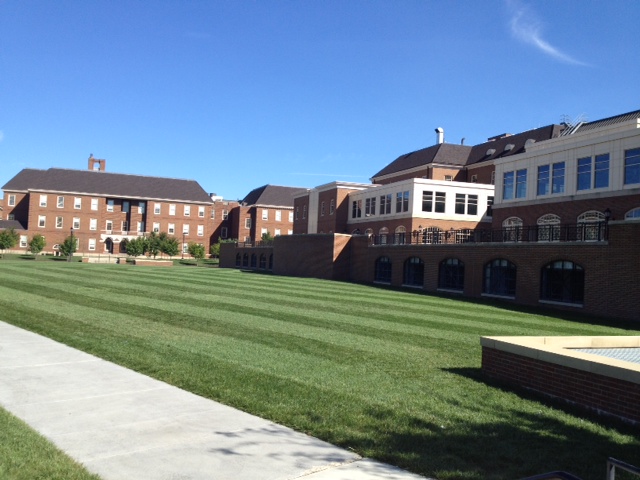
Today was a wonderful day.  I had the chance to travel to Miami University (a truly beautiful campus as you can see in this picture I snapped while walking on campus today) where I attended a meeting called Articulation where all of the Ohio 2-year and 4-year colleges meet with high school counselors to provide us with an update about their latest information and any special admissions related details we need to be focusing on when working with students for the year.  This is always a helpful meeting, but what truly made today special was the fact that I had the opportunity to meet with 5 of my former students who are now attending Miami!  It was wonderful to be able to walk around campus with them, to see where they live and take classes, and hear about their experiences as a college student meant so much to me!  

I am pictured above with  Riley Brehm (Class of 2012) and Kristin Black (Class of 2010).  I am so grateful that Jonathan Black, Kristin Black, Riley Brehm, Carly Cameron and Cole Doran were able to set some time aside to meet up with me.

My visit to Miami and the chance to explore the campus reminded me of the importance of making a college visit and seeing for yourself the feel of a campus.  Please remember that you (the student) needs to be the one reaching out to the college admissions office to set up the appointment to visit campus.  During your campus visit, you should also ask questions as you tour the school to help you develop a clearer impression of the school. After each visit, review the list of questions that you use to see if there are any other questions you might want to add. Remember, you are visiting campuses to get a feeling for the atmosphere of each place – something you can’t get from a brochure or website.  Below are some questions that might provide a helpful starting point as you determine what you want to ask and see while on campus.

Questions to Ask During a Campus Visit:- What activities and services are available to help students get settled (academically and socially) during their first year?
- How big are the classes?
- (Ask students) How easy is it to meet with faculty?
- (Ask students) Are you able to register for the classes you want?
- What is the total cost of attending the college?
- What types of financial aid does the college offer and how do I apply?
- Are all freshmen assigned to an academic advisor?
- Where do most freshmen live?
- Can I take a tour?
- What activities are available for students?
- Who teaches the majority of the courses for first-year students?
- How successful are the college’s graduates in finding jobs?
- What services (such as transportation and shopping) are available locally?
- What is there to do on weekends? Do most students stay on campus or leave on weekends?
- Are the dorms spread throughout the campus or clustered in one area?
- Is there any kind of shuttle service between classroom areas, the library, the student union, and dorms? How late does it run?
- Is there a security system to bar outsiders from entering dorms?
- How large is the campus security police force? Does it patrol the campus regularly?
- What services are offered by the campus health center? How large is it?
- Does the student health center refer students to the local hospital? Is there a nearby hospital? How large is it?

Ask Students:- How many of your courses are taught by a big-name professor and how many by a teaching assistant?
- Is the teaching innovative and project oriented or is it mostly lecture oriented?
- Do most freshmen class lectures take place in an amphitheater?
- What are the strong majors? What are the weak majors?
- How hard do you have to work for your grades?
- What’s the reputation of the ________ department?
- How adequate for your needs is the campus computer network?
- Do fraternities and sororities dominate the social life of the college?
- What do students do on weekends? Do most go home?
- How is the advisement system? Do you feel your professors really care?
- How helpful are the other students if you miss a class? (Are they willing to share a copy of their notes or review the information covered with you?)
- There are a lot of organizations on campus. Are they dominated by a few groups or is anyone welcome?
- How active is the ___________ (fill in the activity in which you are interested)?

Pay Attention to/ Take note of:- Are the dorms quiet or noisy? Do they seem crowded?
- How large are the dorm rooms? Is there adequate space and light to study?
- Does each dorm room have access to the internet and the campus LAN?
- What’s advertised on dorm and classroom bulletin boards? What does this tell me about campus life?
- How good is the lighting around each dorm, classroom, and lab buildings?
- Do the buildings and grounds look well cared for or do they need painting and general repair work?
- Is the grass cut and are the grounds landscaped?
- What’s the condition of the playing fields and the sports equipment?
- How is the quality of the food in the cafeteria or dining hall? How are the sizes of the portions? Is it healthy or fast food? Are there meal plans?
- Does it look like there is much to do outside of campus?
- How easy is it to get to places off campus?
- Are there places within walking distance?
- Are there places to get extra furniture, like bookcases, for your dorm room?
- Is there a supermarket nearby to stock up on snacks and soda?
- If you move out of a dorm after freshman year, what are the options in apartment complexes or buildings?

Things to Ask Yourself:
- While waiting how did the staff members that you observed interact with students? Were they friendly or did they approach students – both potential freshmen like you and enrolled students – as if they were interfering with the staff members jobs?
- Was the Admissions office a friendly and inviting place with a great deal of information about the school or was it cold and sterile with little information to pick up?
- What did your parents find out about the career planning services offered to graduating seniors and to graduates? What do the services include?
- Do most of the students seem to be like you or are they completely different? Can you imagine being friends with the people you see on campus?
- How would you feel being in a classroom full of these students? Sharing a dorm with them?
- Do the students try to make you feel at home? Are they happy to answer your questions or do they make you feel like you’re intruding? How do they interact with one another?
- Does the campus seem too big or too small?- Do freshmen live in their own dorms? How do I feel about living in a single-sex or coed dorm?- Do you feel comfortable and safe?
- Think about the kind of person you are. Are you a self-starter or do you need someone to motivate you? Do you like being part of a crowd or would you rather be alone or in a small group? How important is it to be near your family? How comfortable are you with challenging courses?
- Compare your offers – financially and what the school has to offer. Make a list of pros and cons of each school and the key reasons for your decisions. Remember some factors may be more important to you than others.

After the Visit/ Interview:
- Write thank you notes to your interviewer and anyone else you met with formally, such as a coach or a professor.
- If you spoke with any students and traded e-mail addresses, send an e-mail thank you.

I also want to remind you that it can be very helpful to spend some time on campus simply observing - people watch, look at the campus newspaper and bulletin boards.  It can also be helpful to eat on campus to get an idea of the quality and variety of the food choices.  Often times many students feel that college visits are the part of the college search process that is the most fun.